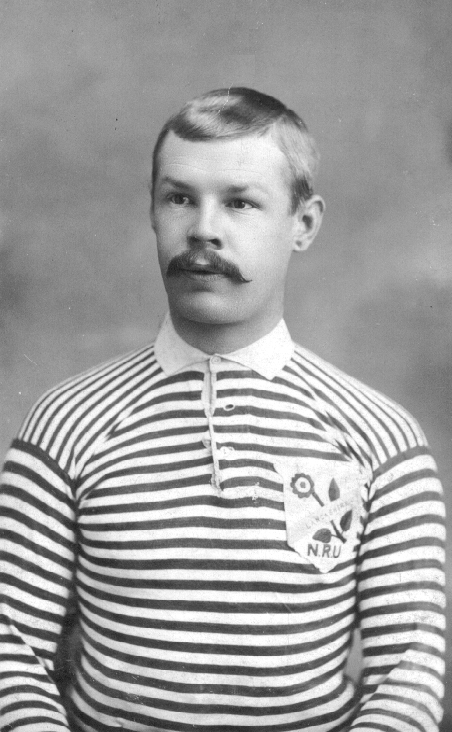
Arthur Lees was born in Lees village in 1874 and played his first football with the Leesfield Trinity club, which was founded by his namesake, Sam. He joined Oldham during the 1892-93 season in the midst of a 20 week cotton strike. He was employed in “King Cotton” and recalled in an interview in 1925, “I had nowt to do but play football everyday”.
He made his senior debut at the age of eighteen and by the time of the formation of the Northern Union, he was the regular half back partner to skipper Harry Varley, who he regarded as the best half back to have ever played the game. Later he would form a great partnership with stand off Joe Lawton.
Arthur was promoted to club captain part way through the 1898-99 season, leading his team to the Northern Union Final and had the honour of being the first Lancashire captain to hold aloft the Challenge Cup, after the victory over Hunslet at Fallowfield.
He was a regular for Lancashire and captained the red rose outfit to the County Championship in 1900.
The Lees brand of half back play give rise to many a trick in order to outwit the opposition. One of Arthur’s favourite ploys was to make a big fuss about telling his stand off exactly where to position himself at a scrum near the opposition try line and then when the possession was won, his partner would scamper off without the ball drawing away the defenders, while Arthur would keep the leather and burrow through the pack to score. This manoeuvre brought about a last minute try and conversion to win a second round cup tie l4 -10 at Batley in 1905.
Arthur was very proud of his achievements with the club and kept as souvenirs the ball from the 1899 Cup Final and also the ball from a 23 – 0 victory over Hull at Watersheddings in April 1905, which clinched the Championship,‘ both of which were inscribed with the match details in gold ink. (Where are they now, I wonder?)
His last game for the club was in the Challenge Cup Final against Warrington on April 27th 1907. He kept up his involvement with the club by coaching the “A” team for a year and was then elected to the committee.
Without doubt he was one of the greatest figures in the history of the club.
Player profile
Arthur Lees was born in Lees village in 1874 and played his first football with the Leesfield Trinity club, which was founded by his namesake, Sam. He joined Oldham during the 1892-93 season in the midst of a 20 week cotton strike. He was employed in “King Cotton” and recalled in an interview in 1925, “I had nowt to do but play football everyday”.
He made his senior debut at the age of eighteen and by the time of the formation of the Northern Union, he was the regular half back partner to skipper Harry Varley, who he regarded as the best half back to have ever played the game. Later he would form a great partnership with stand off Joe Lawton.
Arthur was promoted to club captain part way through the 1898-99 season, leading his team to the Northern Union Final and had the honour of being the first Lancashire captain to hold aloft the Challenge Cup, after the victory over Hunslet at Fallowfield.
He was a regular for Lancashire and captained the red rose outfit to the County Championship in 1900.
The Lees brand of half back play give rise to many a trick in order to outwit the opposition. One of Arthur’s favourite ploys was to make a big fuss about telling his stand off exactly where to position himself at a scrum near the opposition try line and then when the possession was won, his partner would scamper off without the ball drawing away the defenders, while Arthur would keep the leather and burrow through the pack to score. This manoeuvre brought about a last minute try and conversion to win a second round cup tie l4 -10 at Batley in 1905.
Arthur was very proud of his achievements with the club and kept as souvenirs the ball from the 1899 Cup Final and also the ball from a 23 – 0 victory over Hull at Watersheddings in April 1905, which clinched the Championship,‘ both of which were inscribed with the match details in gold ink. (Where are they now, I wonder?)
His last game for the club was in the Challenge Cup Final against Warrington on April 27th 1907. He kept up his involvement with the club by coaching the “A” team for a year and was then elected to the committee.
Without doubt he was one of the greatest figures in the history of the club.